
Rosella Jam | Small Batch
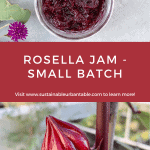
Rosella Jam is a treat well-known to Australians. Sadly though, it’s not something that’s easy to come by. Generally, if you’d like rosella you grow your own, and that’s exactly what I did this year!
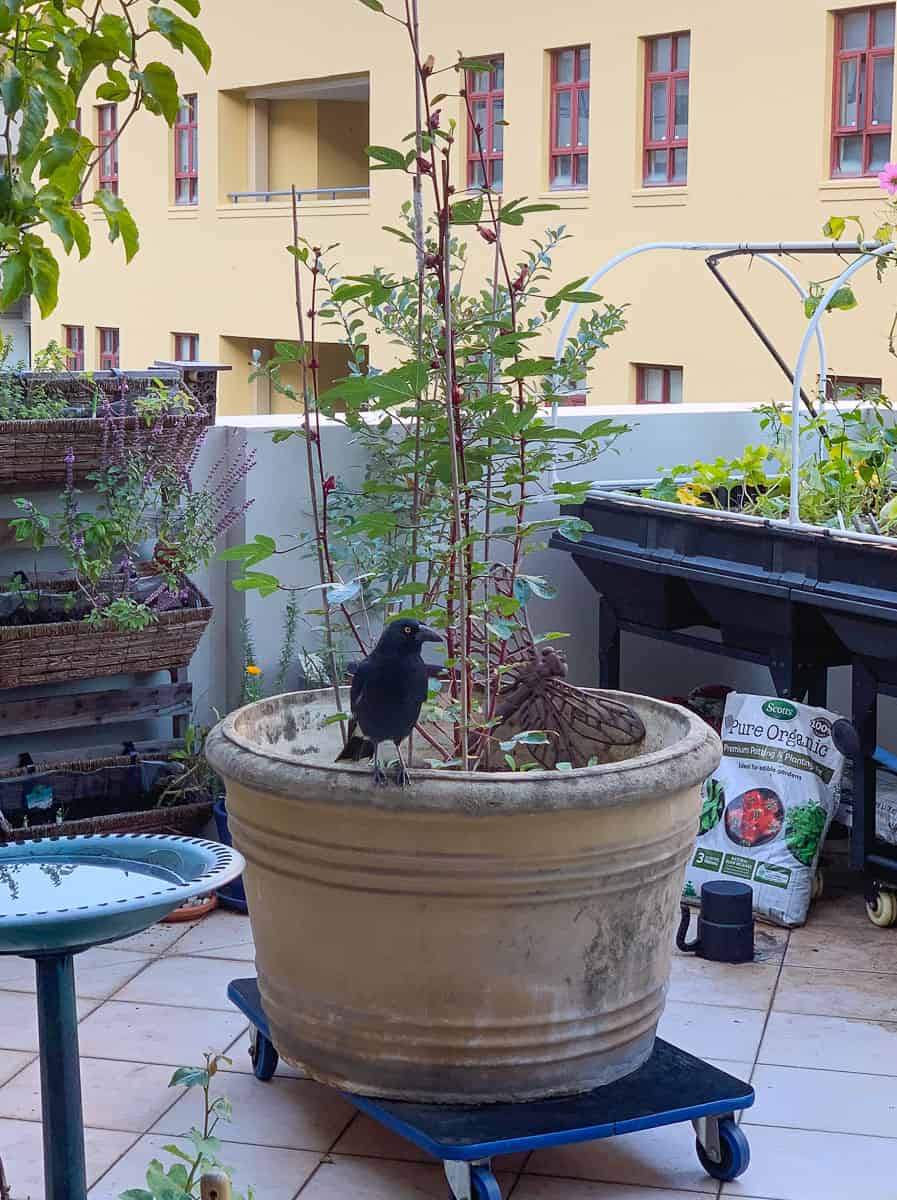
The plant is quite hardy and will produce an abundance of fruit as well as beautiful flowers. The trick is to ensure you keep harvesting them as they ripen to encourage more growth.
This season I largely dehydrated the leaves to keep aside for rosella tea. I also infused some in honey, which has been delicious. As the season came to a close though I had two small handfuls left on the rosella bush. So, rosella jam it was, albeit a tiny batch.
Do make sure you keep some seedpods aside so you have seeds to grow next year too.

A Bit About Rosella
Rosella, also known as wild hibiscus, is ruby red with a deliciously tart flavour. It is known as an Australian bush tucker food but it’s not actually a native, and was imported from Africa. I’ve read also that others believe it was imported from Indonesia however, most sources agree on Africa. I believe it was in fact the Egyptians who first made it into a tea too.
It’s traditionally considered a wild grown food but it’s also popping up in many backyards. I was introduced to it by a friend and found it in my community garden, which is where I fell in love with it.
Additionally, rosella is rich in vitamin C and antioxidants so is a wonderful food to include in your diet.
How To Make Rosella Jam
The great thing about making rosella jam is that the same recipe works with any quantity of fruit.
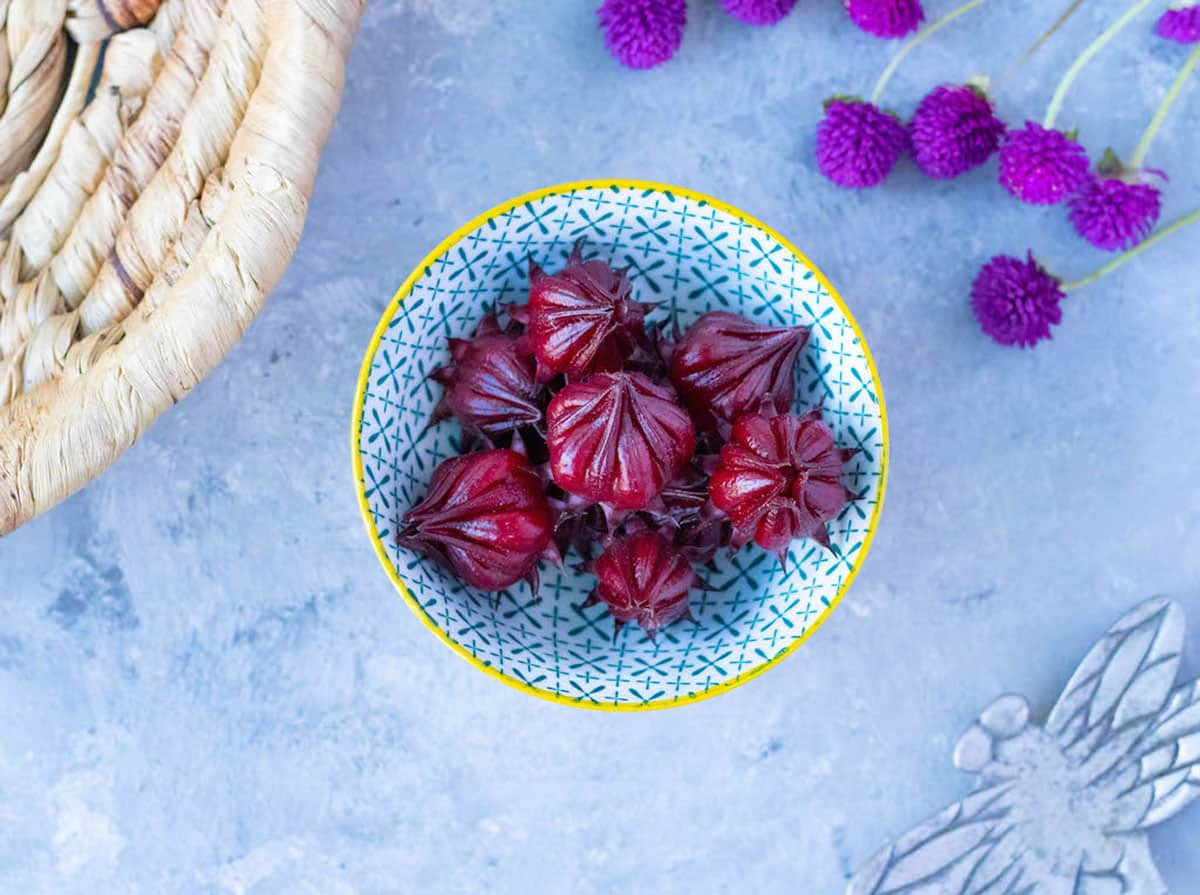
All you need do is remove the calyxes (red leaves) from the seedpods for the volume of fruit you have. It was 14 for me today, which was loosely – one cup.
You then wash the calyxes and the seedpods separately because you’ll be using both parts.
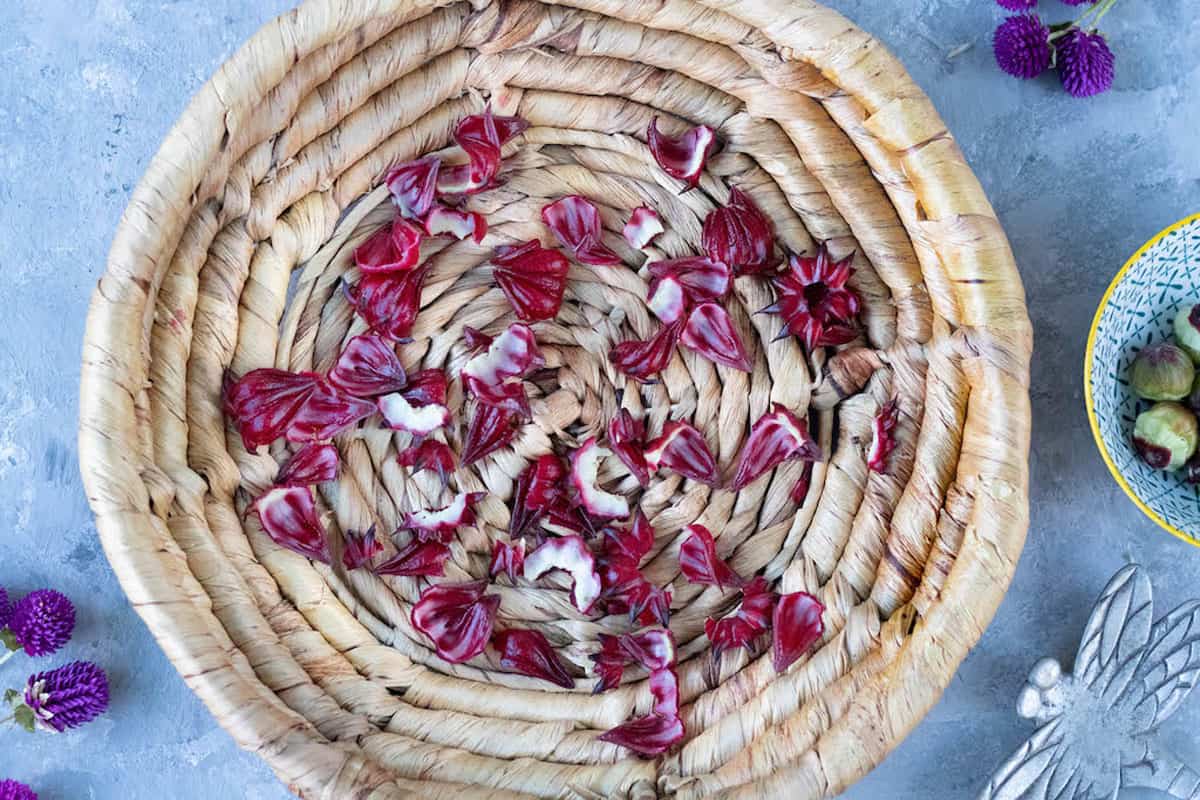
The seedpods are useful as they contain the pectin that helps the jam set. I like to slightly pierce the seedpod too.
You then add the volume of pierced seedpods you have to a saucepan and just cover them with water. Boil for 20-30 minutes or until soft.

Once that’s done, strain off and keep the liquid and put the seedpods in the compost.
Return the liquid to the same saucepan and add in the washed calyxes. Bring those to a boil and cook for another 20 minutes or until the liquid has thickened.
Remove the saucepan from the heat and measure the volume of cooked pulp. Return it to the saucepan and now add in the same volume of sugar along with the squeeze of lemon juice. Bring to the boil and cook for 10-20 minutes or until the jam has thickened then transfer to a jar and keep in the fridge.
See how easy it is? And why you don’t need to rely on a set recipe but rather – the volume you have on hand? That’s what I love most about this jam.
More Jams To Try
If you try this recipe, I’d love to know. Leave a comment, rate it, and remember to tag @wholenaturalkitchen in your pics or reels on Instagram, Facebook or TikTok!
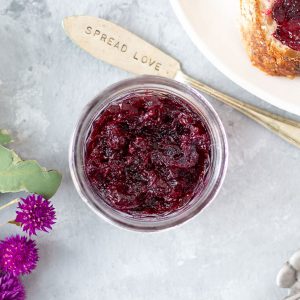
Rosella jam – small batch
Equipment
- Small saucepan
Ingredients
- Ripe rosella fruit
- Raw sugar
- Filtered water
- Lemon juice, just a squeeze
Instructions
- Remove the calyxes (red leaves) from the seed pods then wash and drain them separately
- Slightly break open the seed pods and add them to a small saucepan. Pour in filtered water until the pods are just covered. Do make sure they're submerged
- Bring to the boil and cook, covered for 20 minutes or until the pods are soft
- Strain and keep the liquid and put the seedpods in the compost
- Pour the reserved liquid back into your small saucepan and add in the washed calyxes. If the calyxes are not submerged in water add a tiny touch more filtered water
- Boil down for another 20 minutes allowing the mixture to thicken
- Remove from the heat and measure the volume of cooked pulp. Return this to the saucepan and add the same volume of sugar along with the squeeze of lemon juice
- Bring to the boil and cook for 10-20 minutes or until the jam has thickened
- Transfer to a clean jar and store in the fridge
Notes
Nutrition
Pin This Recipe For Later

Gabby Campbell
Gabby is a degree qualified Naturopath/Nutritionist (BHSc Nat) and published health writer. After many years in clinical Naturopathic practice, she moved to recipe development and online education to combat the abundance of misinformation about food and health online. Every recipe Gabby creates is shaped by her clinical knowledge. All use simple, everyday ingredients and many cater to common dietary needs like being gluten-free and dairy-free. MORE ABOUT GABBY
how about a sugar free alternative for diabetics?
Hi Shane, sugar free rosella jam gets a little trickier because the sugar plays a role (along with the pectin from the seeds) in helping the jam set. I think what might work, is making a rosella chia jam, where chia seeds are doing the setting work for you and you can replace the sugar entirely with a tablespoon or less of monk fruit or your sweetener of choice. In this instance I would simply boil the calyxes down in a little water for 20 mins or until soft and most of the liquid had evaporated. Then, stir in a squeeze of lemon juice, add your sweetener, and the chia seeds (usually 1-2 tablespoons depending on fruit volume) and stir well to combine. Tip the jam into a jar and let it cool and set before storing in the fridge. I’m sorry I can’t be more precise with measurements here, but this is just me thinking out loud until next rosella season here when I could give this a go myself.
I found that when I added the calyx’s to the cooked seed liquid, I followed your instructions to make sure I had the calyx were covered with liquid, so I added more water. Did not realize that the calyx cook down into the liquid. So I had far too much liquid in my Jam, So I ended up adding a heap of corn flour to thicken. Seemed to taste OK, but need to cook down the calyx into the liquid, before deciding if adding more water is needed. Just a suggestion.
Hi Gabby,
If I have five cups of rosella calyxes should I increase boiling time or 20 minutes still should produce enough thickness?
I appreciate your advice.
Hi Yvonne, in all honesty I have never actually had this volume to work with from my shrub. What a haul! But, in short, yes, it will take longer based on other jams I’ve made with larger amounts of fruit. Some tips that I hope will help. Use a wide pot to ensure maximum surface area is available for evaporation of the liquid as the rosella cooks down. That way, it won’t take forever though a 5-cup batch could easily take 40 to 60 minutes to reach a set point. Keep an eye on the jam and once you think it looks like it’s starting to thicken up, I would highly recommend testing via the frozen saucer method. Are you familiar with that? If not, when you start your jam just pop a small saucer in your freezer. When you think the jam looks thick enough and want to test it, remove the saucer place a teaspoonful of jam on it, let it sit for 10-15 seconds then run your finger through the jam. If it stays separated in two parts, the jam is ready. If not, cook it down a little more and try again. Always remember to wash off the saucer and put it back in the freezer before re-trying!
Hi there, super excited to try this recipe but am wondering if I could use honey or maple syrup in lieu of sugar?
Hi Samantha, this is not something I’ve tested but I make a lot of my jams with honey (like this Strawberry and Rose Water Jam) so you could absolutely try that. The complexity with doing that with this recipe though, is that the pulp is weighed and then matched with the same amount of sugar. Honey will add more liquid to the recipe so I would suggest using 3/4 of the amount of pulp in honey. As an example, if you had one cup of pulp you would generally add one cup of sugar. If you’re adding honey instead, you’d just add 3/4 cup. Hope that makes sense!
I clipped all of one bush and hoping they put out more.I have one left for seeds.I am going to try this recipe because it sounds so good.Thank You
I hope you love it Barbara! This is my favourite jam. It’s such a delicious seasonal treat.
it was delicious
I cannot get rating to click but I have it a 5 that’s all the stars there is but if more I would give more.This was so good and I will be making my next season.I filled a few gift jars and kept me a jar.It is delicious.Thank You so much.
Thank you so much Barbara. That’s wonderful to hear! I can see your 5 star rating (thank you!) so not sure why it wasn’t showing your end. This is such a unique gift too, everyone always loves it!
I’d love a version of this that can be canned safely for longer shelf stable storage.
Hi Melissa – to the best of my knowledge (and research) rosella/hibiscus has not been tested as safe for canning – though the fruit does have a high pH so technically should be. I’ll keep researching that for further clarification though. This aside – the other complexity is that rosella is not available commercially here – I’m in Sydney, Aus. This means growing your own and I’m a balcony gardener so have never had a crop big enough to produce the volume you’d want to can! I will see if I can get several shrubs going next season to give it a go.
fantastic little recipe. simple, easy to adjust the quantites, tastes delicious and is the prettiest colour jam.
Thanks so much Nadine! So glad you enjoyed it. I absolutely love the colour too, it’s so gorgeous.
Hi Gabby, I always come back to your recipe each season. I have black Rosellas for jam. Just wondering about adding Chilli to brew
Hi Alison – I apologise profusely for this delayed response. I’ve been travelling in outback Australia with little to no access to the internet and my website was a bit heavy for the very slow loading speeds I had on offer, so I couldn’t get in! Now to your question – I can’t say I’ve ever tried that and wonder how they’d pair but then we do have sweet chilli sauce so I can’t see why it wouldn’t work. I’d just do one small batch to try this out. When making a chilli jam you’d usually whizz up the chilli with other savoury ingredients before adding it to the pot. For this recipe I wonder if just slicing a chilli down the middle and adding it with the seed brew would be enough. If you try this out I’d love to know the outcome! Rosella season is over for us but I will be keen to try it next year. And I’m so glad you come back to visit me here each rosella season!